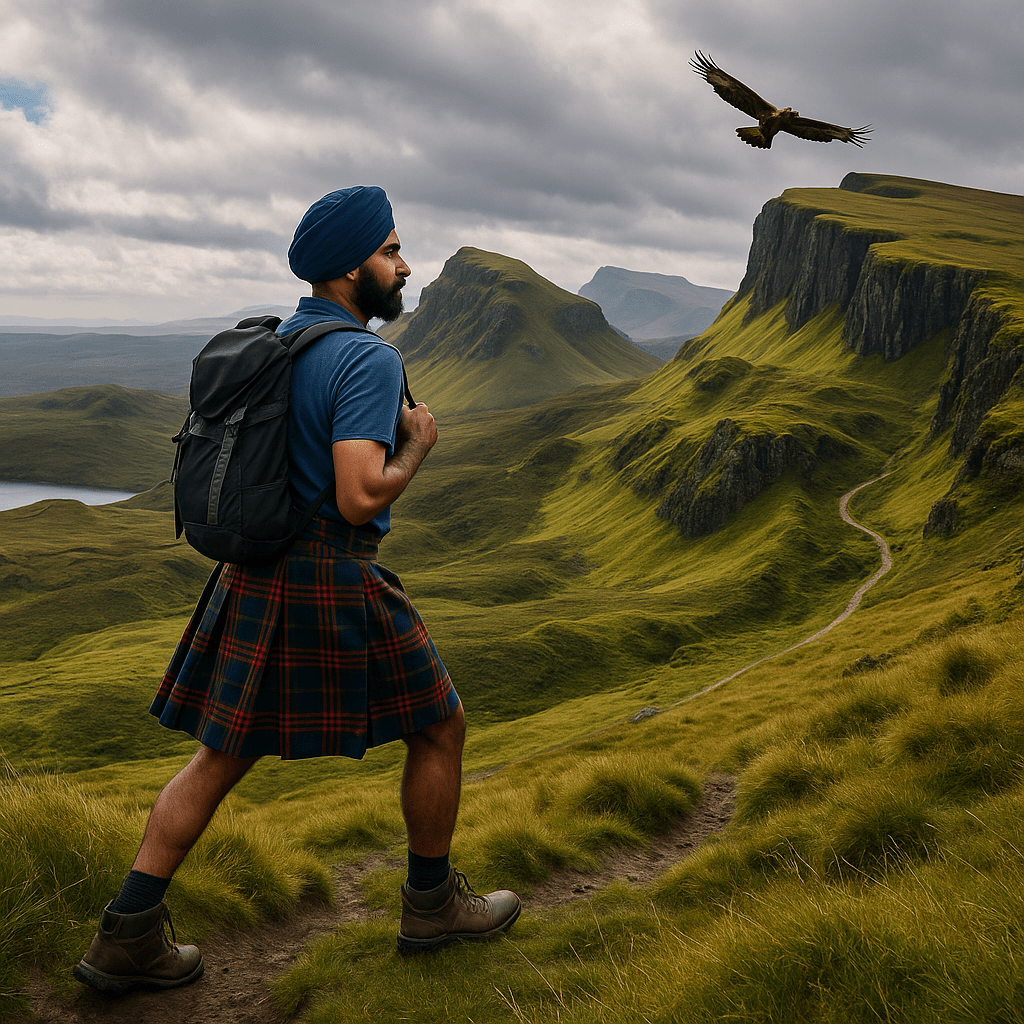
Arrival in Inverness
I arrive in Inverness and the moment I step off the plane, a palpable weight lifts from my shoulders.
A few steps further and a man cracks a joke about the weather. It’s cooler for sure. But also satisfyingly crispy, like a praline wafer. He’s from Stornoway, of the Outer Hebrides, where I lived for two years. He’s with a friend—they’ve been at Buckingham Palace for a cancer event with the King.
We discuss the isle of Lewis and Harris and all the familiar spots I used to love, including Tiumpian Head, the lighthouse where I found myself idling time away, whale-watching with local friends during the pandemic (we were some of the lucky ones). He has that familiar twinkle in his eye of a Lewis man. Hardy, self-sufficient yet playful. Both of them have that quintessential islander openness and keenness for a playful natter. Strangers are not dangers to them.
South of England & Lost Connections
I never realised how withdrawn, separate and disconnected the culture of the South of England is until I left it five years ago and came up to Scotland, and travelled extensively. It’s progressing too—community is being eroded even more. And with phones, people are turning ever more inward. Between 1985 and 1994, one study showed community organisations fell by 45%.
On the plane, I was reading Lost Connections by Johann Hari. It describes how depression is often not a disease of the mind as many believe, but rather that it’s rooted in disconnection. Disconnection from purpose, disconnection from others, disconnection from self and emotions. And nature. Healthy communities, having down time and spending time outdoors are protective against depression.
Loneliness & Its Consequences
A lonely person spots potential danger in half the time a socially connected person does. They unconsciously know that no one else is looking out for them. They don’t have a tribe. That doesn’t mean that danger is there though, just that they are less trusting and more anxious. They take offence when offence isn’t intended. They judge more. They shut themselves off from the very thing they need most: connection.
The tragedy is lonely people become harder to be around, perpetuating the cycle, as they snowball into an even colder place. It can be reversed, but through a lot more reassurance and love than they would have needed in the first place.
They become more physically unwell too—lonely people are three times more likely to catch a cold than a socially connected person, and a nine-year study demonstrated they’re 2–3 times more likely to die.
The Medicine People Need
At work, I see so much loneliness. People need lives more conducive to connection more than medicine. But our society values individualism over community, competition over collaboration, efficiency/scalability over soul and creativity, certainty/planning over uncertainty/flow. And people are becoming ill because of its rigidity.
When I lived in the Outer Hebrides, I was part of a community and connected to nature. People nattered. People created and shared for the sake of creating and sharing, not for money. It was a nice blend of social capitalism. Purpose is borne out of their community as people have roles to play for others in it.
When I lived there, I wasn’t so immersed in individual problems, financial pressure or personal goals.
Currently it feels like the living equivalent of battery–vs–organic farming.
Fires, Friends and Forests
I spend the weekend with friends Jimmy and Kass, and their little one Muireann. We camp out on the beach of the Moray Firth. We amble the forest bed picking up loose wood to top up our campfire before heating up and gorging on our Hebridean tradition: slow-braised homemade venison casserole.
In the morning, after clambering out of our tents from cold, interrupted sleep with the help of a strong coffee, we rise up to a view of gannets diving for their morning fish feast. We join them for an ice-cold dip. Invigorated, we stroll the beach and discover a 2m washed-up dead skate fish. We hike in the Cairngorms in Lord of the Rings’ scenery. We run a local trail along the River Findhorn, spotting a few spring salmon along the way. The immersion in nature and connection with old friends soothes my bubbling pot of thoughts and emotions.
The Way of the Hermit
Jimmy and Kass gift me a book: The Way of the Hermit by Ken Smith.
I watched a special movie on his way of life a couple of years ago. Ken let go of mainstream society to live off the grid as a ‘hermit.’ Inspired by his character, I made my final trip before I left Scotland a solo hike overnight to Loch Treig where he lives. I read the prologue of his book which finishes with:
“I’ve spent the majority of my life living outside of the conventions of mainstream society, and I’ll tell you what I think is weird, and it ain’t the hermit.
It’s how entire generations of people have been conned into believing that there is only one way to live and that’s on the grid, in deepening debt, working on products you’ll probably never use, to line the pockets of people you’ll never meet, just so you might be able to get enough money together to buy a load of scrap you don’t need, or if you’re lucky, have a holiday that takes you to a place, like where I live, for a week of the happiness I feel every day. And then they have the bloody cheek to guilt you into somehow being grateful for it?
No, I’m pretty certain I’m not the weird one, and yet here we are my friends.”
Resignation
I haven’t heard anything back from work about my request to reduce my hours—their communication is always painfully slow and drawn out. Enough. Ken Smith’s illuminating passage drives me to formally write in my resignation notice for three months’ time. Things must be more on my terms now.
I formally state my last day of work: 31st July. I ask for reduced hours and protected time during the notice period I am working if they want me to consider staying on. If they agree, I’ll use the next three months as a trial but will only need to give a further months’ notice if it doesn’t work out.
This week I read that satisfaction for GPs in NHS practices working under a private provider is between 9–22%. Realistically, I cannot see myself staying there long-term but Scotland helps unpick my inner conflict:
I want to leave. But preferably, helpfully.
 Mindful Medic