I arrived at the conference with low expectations. Honestly, I wasn’t chasing inspiration — I was chasing a catch-up with my friend Stephen, a fellow GP with a leadership role. The fact that it was in Glasgow — my old stomping ground — made it an easy yes.
I’ve worked in national-level leadership before, but over time, a quiet apathy from working in a tough system has settled in. With the isolated nature of day-to-day work as a GP, this disconnect has perhaps also spilled over into how I felt about the profession as a whole.
But—unexpectedly—the conference stirred something in me. It was sharp, emotional, and energising and I left feeling proud of the GP profession. From the very beginning, the tone resonated. Dr Matt Mayer, the chair, introduced the conference with a disarming wit and set the wheels in motion for a 2 day affair that ran with the pragmatic efficiency hoped for from a resource-constrained system.
What Even Is the LMC Conference?
The BMA (our main trade union and professional body representing doctors) UK conference for Local Medical Committees (LMCs) is a yearly affair bringing together over 500 representative GPs across all four nations. It has a fascinating, engaging format for member-led decision-making and active participation.
LMCs are committees of area-specific GPs that represent our interests to NHS bodies such as NHS England or local Integrated Care Boards (ICBs). The number of organisations involved in the NHS is confusing—and, helpfully, every few years most of them like to change names and structures too. It’s a bit like keeping tabs on a herd of migrating, camouflaging, hibernating, fast-reproducing, short-living creatures.
The conference is an opportunity for these GP-comprising LMCs to raise issues relevant across the UK and influence national BMA policy—to protect the interests of GPs, patients, and the wider system.
Motions, ‘Littles’, and the Art of Debate
LMCs submit motions to the national BMA conference committee, which selects those to be debated before any policy changes occur. Each motion is made up of ‘littles’—specific, focused points that form the building blocks of a broader argument.
The motion and its littles are proposed by a GP speaking on behalf of their LMC, often delivering an impassioned 5-minute speech. GPs from the audience then have the opportunity to speak for or against the motion (or any of the littles) in one-minute slots. Many suggest amendments, while others support or oppose outright. Some motions—such as those on assisted dying or transgender legislation—sparked emotionally charged, polarised debate. For the most part, the tone was deeply sensitive, passionate, and respectful. And at times, invaluably, sprinkled with playfulness.
The chairs of the conference allowed time extensions for important debates and hurried things along when needed. After concluding statements and clarifications, the broader motion and its components were voted on. For routine matters, we voted by raising green or red cards. But for sensitive topics, such as discrimination against International Medical Graduates, digital voting protected anonymity.
The GP Workforce Crisis: Hard Truths
One of the most urgent, eye-opening, and emotive topics on the first day was the GP workforce crisis—a result of decades of underfunding and poor workforce planning.
Patients are finding it increasingly difficult to access GP appointments, yet GPs face unprecedented levels of unemployment. The government’s strategy has shifted toward ‘GP-lite’ models, funnelling funding into the Additional Roles Reimbursement Scheme (ARRS). This approach aims to delegate traditional GP work to Clinical Pharmacists, Social Prescribers, Physician Associates, Paramedics, and Advanced Nurse Practitioners— essentially offloading doctors work onto non-doctors. Ironically, GPs are still required to supervise these practitioners.
I believe in system evolution. When ARRS roles are used to support GPs by offloading work that can safely be done by non-doctoring professionals, they’re helpful. But when implemented as a substitute for the complex, relational work that GPs do—it’s a disaster. It’s causing stress for patients, non-GP staff, GPs themselves, and the broader system.
Our own Advanced Nurse Practitioner, Claire, has expressed concern about the risks of managing patients who really need to see a GP. She’s raised this repeatedly. (Although admittedly, complaining is her modus operandi).
What Struck Me Most: Raw Stories of Struggle
A host of remarkable stories were shared by GPs—personal accounts of how this broken system is affecting lives:
- GPs struggling to pay bills and mortgages, taking jobs as Uber or bus drivers
- An anonymous GP staying in an unhappy marriage due to financial insecurity and joblessness
- GPs earning less than they did as junior doctors two years ago
- A charity, the Cameron Fund, stepping in to support GPs financially
- GPs offering to work for free just to keep their license valid (40 sessions required yearly)
- GPs commuting several hours to secure work
- A GP leaving their family behind in the UK to emigrate to Canada for stability
And even for those GPs who do have work, things aren’t rosy. A BMA report summarised current pressures:
- Declining GP numbers and rising patient lists = worsening GP:patient ratios
- Burnout
- Poor continuity of care (which remains the most evidence-backed predictor of good patient outcomes)
- Substitution of GP care with less-qualified staff, increasing both cost and risk to the system
The Mental Health Cost of Carrying It All
There was a particularly moving session on the mental health of GPs. A motion was proposed calling for dedicated, confidential mental health and wellbeing services for primary care staff.
Burnout levels in General Practice have reached Kilimanjaro-like heights. Harrowing stories emerged—of mistakes made under pressure, guilt that lingered, and preventable suicides. There are tragic cases, such as that of Dr Gail Milligan, who took her own life despite actively seeking mental health support.
The support structures for GPs who are crumbling under clinical pressure, admin burden, regulatory oversight, complaints, and staff shortages? They’re not fit for purpose. This motion aimed to change that.
A Closing Note, and a Ceilidh
This wasn’t exactly what you hope to hear three days after handing in your resignation to step back from the chaos. It also surprised me — not because it wasn’t significant, but because hardly anyone seemed to be talking about it. So much for “no news is good news” — sometimes, no news is just… quietly buried’
But these times—this mess—we’re in are part of the natural rhythm of systems. An endless flux between order and chaos, abundance and scarcity, creation and destruction.
“Hard times create strong people, strong people create good times, good times create weak people, and weak people create hard times.”
And within these hard times? There is still strength, creativity, and courage. This conference proved that. Compassion, kindness, fervour, and connection were abundant.
That night, we had dinner at the Glasgow Science Centre. I found myself seated between two wildly innovative GPs. On one side was Cassie, who’d just completed a 20-something-hour kayaking race with a broken wrist. She also happened to be involved in projects like delivering chemotherapy by drone to remote parts of the UK. On the other side was Suresh — a man who had taken over six failing GP surgeries in an attempt to turn them around. He explained that he was currently sleeping just four hours a night as part of an experiment… preparing, as he put it, “for when it might be necessary.” I wasn’t sure whether to be inspired or start doing push-ups under the table.
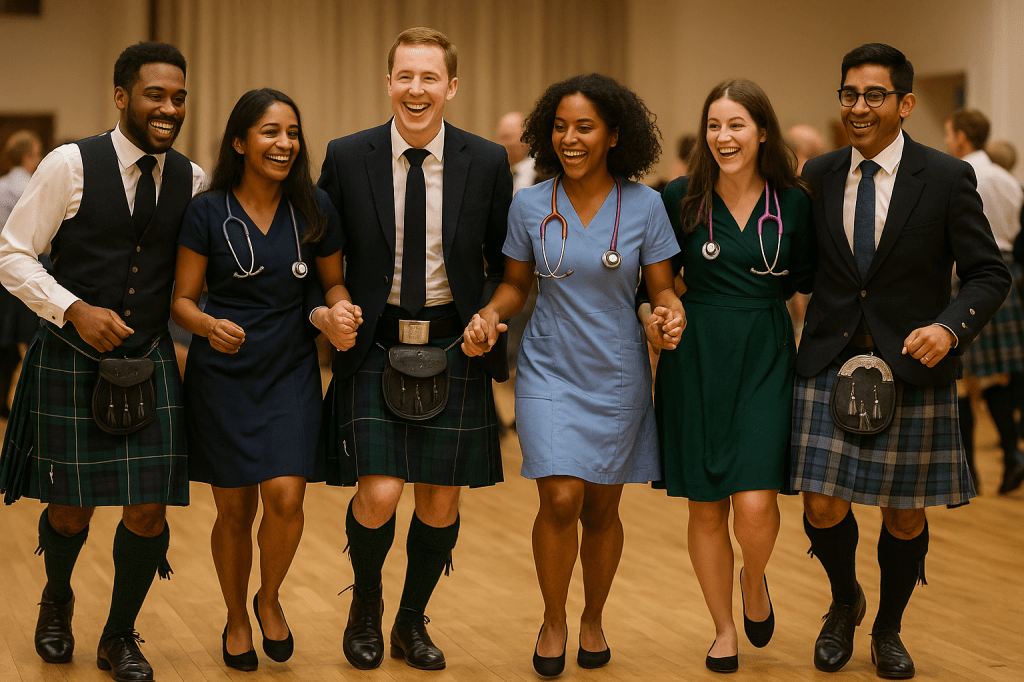
Later, Glasgow’s musical talent lit up the floor, delivering a hell of a Ceilidh. All four nations of GPs—laughing, dancing, and drinking the chaos away.
 Mindful Medic